

Table of Contents
If you’re looking for a clear nigeria e filing court system guide, here’s the short answer: e-filing lets you submit court processes online through a court-approved portal, pay filing fees electronically, and get a file-stamped copy back, all without stepping into a courtroom. It’s now mandatory in some divisions and expanding fast across the country.
That one paragraph answers the basic question. But if you’re a lawyer, a litigant, or a business owner who needs to understand how this actually works in practice, stick around. There’s a lot more to get right.
What Is the Nigeria E-Filing Court System?
The Nigeria e-filing court system is the electronic process through which court users; lawyers, litigants, and self-represented parties; submit legal documents to a court’s registry over the internet instead of in person.
Rather than queuing at a registry counter with a bundle of paper, you log into a portal, upload your processes as searchable PDFs, pay the assessed filing fees online, and receive a digitally stamped, time-stamped copy once the registrar accepts it.
This isn’t a small pilot anymore. It’s becoming the backbone of how Nigeria’s superior courts handle case administration, and understanding it properly is now a basic professional skill, not an optional extra.
Why Nigeria Is Moving Away from Paper-Based Filing
For decades, Nigerian courts ran almost entirely on paper. Case files sat in physical registries, moved between offices by hand, and could take days to travel from a registrar’s desk to a judge’s chambers.
That created real problems. Files got lost, damaged, or misplaced. Backdating and unofficial interference were easier to get away with when there was no digital trail. Litigants outside the court’s city often had to travel just to file a single document.
The Federal High Court’s Chief Judge described the old system bluntly as an “era of paper antiquity” that the judiciary could no longer afford to keep. That sentiment is echoed across the bench, and it’s the driving reason behind the current wave of reform.
A nigeria e filing court system guide wouldn’t be complete without naming the fix directly: digital filing removes the physical bottleneck, creates a verifiable audit trail for every document, and lets registries operate outside the old 2 p.m. counter-closing hours.
Step-by-Step: How the E-Filing Process Works
Here’s what the actual process typically looks like once a court has rolled out e-filing.
1. Register on the court’s e-filing portal. Lawyers usually register using their practicing details, while self-represented litigants may need to create a basic user account.
2. Prepare your documents as searchable PDFs. Writs of summons, statements of claim, affidavits, and supporting exhibits must be uploaded in a format the system can index and search, not scanned images alone.
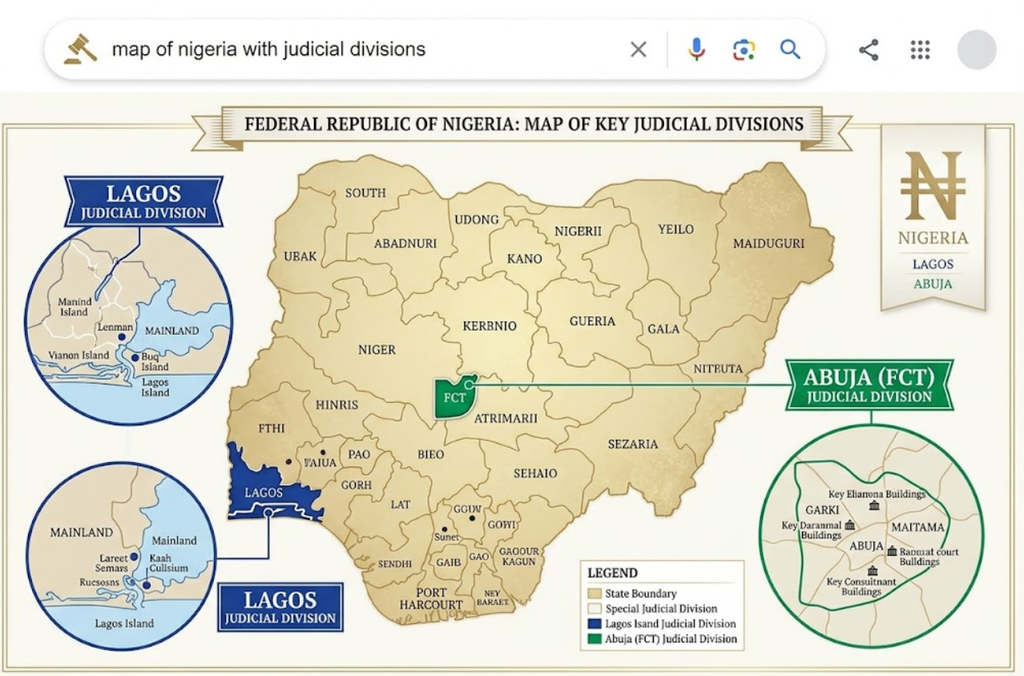
3. Select the correct judicial division. You’ll choose the specific court and division your matter falls under before uploading anything.
4. Upload and submit your originating process. The system logs the exact time of submission, which matters for calculating deadlines and limitation periods.
5. Pay the assessed filing fee electronically. Most platforms calculate the fee automatically based on the nature of the suit, then accept payment through integrated e-payment channels.
6. Wait for registrar acceptance. Once the registrar reviews and accepts the filing, you receive a file-stamped digital copy as proof.
7. Track your case progress online. Many systems now let you monitor hearing dates, case status, and document history from your dashboard.
It’s worth noting that some courts still require a physical copy for initial service under existing procedural rules, so the shift isn’t 100% paperless everywhere yet. Our breakdown of the court filing process in Nigeria goes deeper into how these rules vary by jurisdiction.
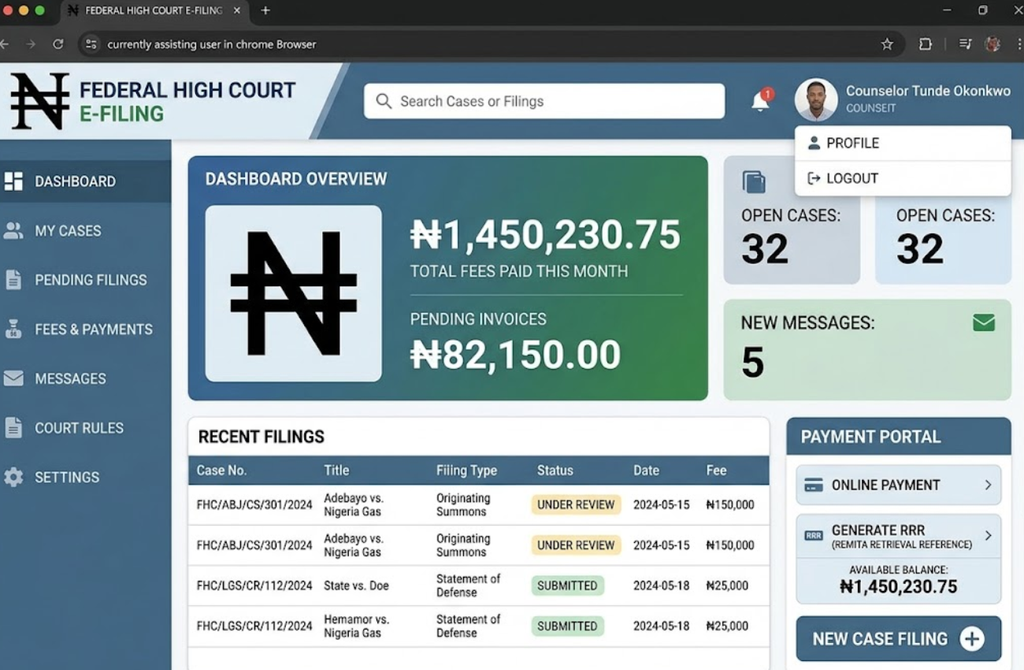
Which Courts Currently Use E-Filing in Nigeria
The Federal High Court launched a formal e-filing system in its Lagos Judicial Division, with the platform designed to cut the time it takes a file to move from a registry to a judge’s desk from days down to seconds.
This sits within a much bigger initiative: the Nigeria Case Management System (NCMS), a nationwide digital infrastructure built to support e-filing and case tracking across superior courts. It’s overseen by the Judicial Information Technology Policy Committee of the National Judicial Council.
The reform doesn’t stop at the Federal High Court. The Supreme Court has introduced its own mandatory electronic filing regime through new Practice Directions, requiring parties in both pending and newly filed matters to upload electronic copies of their court processes and records through a designated portal.
Some state courts have moved even earlier. Rivers State, for instance, developed its own dedicated e-filing platform years before the current federal push. If you want the fuller national picture, our piece on how courts are digitizing in Nigeria tracks the rollout state by state.
Documents You Need Before You Start Filing
Before you touch the portal, get your paperwork in order. Most e-filing systems require:
- Your originating process (writ of summons, originating summons, or petition)
- Statement of claim or supporting affidavit
- Exhibits and annexures, scanned as clear, searchable PDFs
- Proof of your practicing credentials, for registered legal practitioners
- A valid means of electronic payment for filing fees
A quick tip that saves a lot of frustration: scan documents at a resolution that keeps text sharp but keeps file sizes manageable. Portals often reject or slow-load oversized files, and blurry scans can get flagged during registrar review.
Common Mistakes That Get E-Filed Cases Rejected
Even experienced lawyers trip up on avoidable errors when they’re new to a digital workflow. Here are the ones that come up most often.
Uploading scanned images instead of searchable PDFs. Many portals require text-based, searchable documents, not flat image scans, so the system can index content properly.
Filing in the wrong judicial division. Because e-filing removes the face-to-face check a registry clerk used to provide, it’s entirely on the filer to select the correct court and division.
Missing the payment step. A document can sit in limbo if the filing fee assessment isn’t completed and paid before submission is finalised.
Assuming the transition is fully paperless. Some rules still require hard copies for initial service, so skipping that step because “we e-filed already” can create procedural problems.
Waiting until the deadline to troubleshoot. Technical failures happen. Courts have generally clarified that a system outage isn’t grounds to dismiss a case, but that protection works best when you’ve documented your attempt well before the deadline, not after it’s passed.
Our guide on how to file a court case online in Nigeria walks through a cleaner version of this process for anyone filing for the first time.
Benefits of E-Filing for Lawyers, Litigants, and the Judiciary
The upside here is genuinely significant, and it goes beyond convenience.
For lawyers, it means filing from anywhere with an internet connection, no more losing a working day to a physical registry queue. For litigants, it means the ability to submit processes remotely, at any hour, rather than being bound by counter hours.
For the judiciary, the biggest win may be integrity. Digital filings automatically generate a verifiable record with a timestamp, which closes off the old loopholes around backdating and unofficial “expediting.” That single change strengthens public confidence in how cases move through the system.
There’s also a backlog angle worth mentioning. Nigeria’s court system has struggled for years with a mounting pile of pending matters, and faster, trackable filing is one lever courts are using to chip away at that number.
Challenges and Limitations to Know About
No reform this large rolls out without friction, and it’s worth being honest about that.
Internet access and digital literacy still vary widely across Nigeria, which means the benefits of e-filing aren’t evenly distributed yet, especially for practitioners in smaller towns. Courts have also acknowledged that the transition will be gradual; hard copies remain necessary for some procedural steps under current rules.
There’s a cost dimension too. Building and maintaining a secure, reliable e-filing portal requires real investment, and not every state judiciary has the same budget or technical capacity as the federal courts.
Senior lawyers have also been encouraged to delegate the actual filing tasks to junior counsel or IT-savvy staff, which signals that there’s still a learning curve most firms need to budget time for.
How AI Legal Research Complements E-Filing
E-filing solves the “how do I submit this” problem. It doesn’t solve the “where do I find the right law, precedent, or regulation” problem, and that’s usually the harder part of preparing a filing in the first place.
This is where AI-assisted legal research tools fit naturally into a modern workflow. Rather than manually searching scattered statute books or disconnected portals, platforms like Lexark let lawyers search Nigerian laws, regulations, and relevant materials from one place, so the research feeding into a filing is faster and more thorough before you ever open the e-filing portal.
Pairing efficient research with efficient filing is really what a modern, digitally competent practice looks like in Nigeria today. If you want to see how the research side has evolved, our article on judicial information systems in Nigeria is a useful next read.
Is e-filing mandatory in all Nigerian courts?
Not yet everywhere. It’s mandatory in specific courts and divisions, such as the Supreme Court’s new Practice Directions and the Federal High Court’s Lagos Division, with wider rollout ongoing.
Do I still need to submit physical copies?
In some cases, yes. Certain rules still require hard copies for initial service, even where e-filing is available.
What happens if the portal goes down before my deadline?
Courts have generally held that a technical failure or system outage isn’t a valid basis for dismissing a case, though you should document the issue as it happens.
Can individuals without a lawyer use the e-filing system?
This depends on the specific court’s rules; some platforms are built primarily for legal practitioners, while others accommodate self-represented litigants.
Conclusion
Nigeria’s shift to e-filing is one of the more meaningful upgrades to the justice system in recent memory; faster case movement, stronger accountability, and fewer excuses for delay. Understanding the process now, before it becomes fully mandatory everywhere, puts you ahead rather than scrambling to catch up.
So here’s the real question worth sitting with: is your practice actually ready for a court system that no longer waits for paper?