

Table of Contents
Judicial information systems Nigeria are the digital platforms, most notably the Nigeria Case Management System (NCMS), e-filing portals, and the Legal Mail network, that Nigerian courts now use to file, track, store, and manage cases electronically instead of relying only on paper files and physical registries. In 2026, these systems moved from pilot projects to mandatory, nationwide practice, starting with the Supreme Court and the Federal High Court.
If you are a lawyer, a compliance officer, or simply someone trying to understand where Nigeria’s court system is headed, you have probably noticed the shift already: fewer queues at court registries, more file uploads, and a lot of new acronyms. This guide breaks down what judicial information systems in Nigeria actually are, why they exist, how they work, and what they mean for you, in plain language, without the legal jargon.
What Are Judicial Information Systems?
In simple terms, judicial information systems are the software, databases, and digital infrastructure that courts use to manage the entire life of a case. That includes filing a suit, assigning a case number, scheduling hearings, storing court records, tracking payments, and preserving judgments.
In Nigeria, these systems are coordinated by the National Judicial Council (NJC) through a body called the Judicial Information Technology Policy Committee (JITPOCOM). Their job is to build one connected digital ecosystem instead of leaving each court to invent its own solution. That is the whole point of judicial information systems in Nigeria: consistency, speed, and a paper trail that cannot be quietly altered.
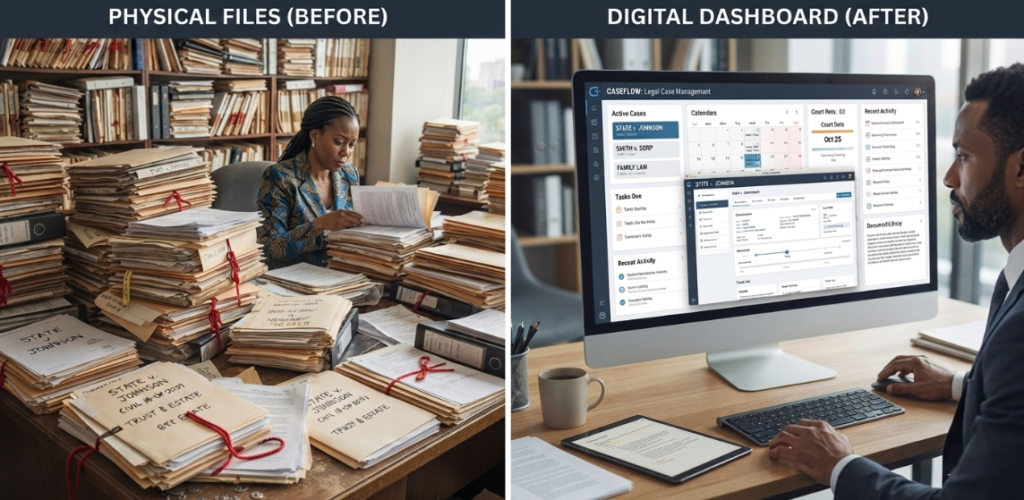
Think of it as the difference between a law firm that keeps client files in cardboard boxes and one that keeps everything in a searchable, secure database. The second firm finds documents faster, loses fewer files, and looks more credible to clients. Nigeria’s judiciary is making that same leap, at national scale.
Why Nigeria’s Courts Are Going Digital in 2026
For decades, Nigerian courts ran almost entirely on paper. Case files moved from office to office in physical folders, hearings were adjourned because a file “could not be located,” and record tampering was a real, persistent risk. Anyone who has filed a case or waited on one knows how frustrating that can be.
Nigeria’s judiciary leadership has been direct about why this had to change. The Chief Justice of Nigeria, Justice Kudirat Kekere-Ekun, has publicly stated that courts around the world are increasingly treating technology as essential for better case management, wider access to justice, safer record keeping, and faster dispute resolution, and that Nigeria’s judiciary cannot afford to stay on the sidelines of that shift.
There is also a security argument behind judicial information systems in Nigeria. According to the CJN, moving from a paper-based process to a digital one increases accountability rather than reducing it, because the integrity of court records is treated as fundamental, and any misconduct around those records is expected to attract serious legal and disciplinary consequences.
There is a real-world example that captures this well. During a serious flood in Borno State, courts using cloud-based digital records were able to keep functioning normally, because their case files were not sitting in a filing cabinet that water could destroy. That single story tells you almost everything about why digitisation matters for a country like Nigeria, where flooding, fire, and simple wear and tear have quietly destroyed court records for years.
Inside the Nigeria Case Management System (NCMS)
The centerpiece of judicial information systems in Nigeria right now is the Nigeria Case Management System, or NCMS. It is a nationwide digital platform built to manage cases electronically from the moment they are filed until final judgment.
The Supreme Court formally began implementing the NCMS in July 2026, alongside a new set of rules called the Supreme Court (Mandatory Upload of Electronic Copies of Processes, Records of Appeal and Other Matters) Practice Directions, 2026. Under these rules, lawyers handling appeals are now required to upload electronic copies of their court documents in addition to filing physical copies, at least for now.
The rollout is happening in careful phases rather than all at once. To begin with, only appeals slated for hearing later in 2026, roughly between September and December, fall under the new upload requirement, giving lawyers a defined window to comply. From there, the Supreme Court intends to widen coverage every quarter until the entire backlog of pending appeals sits inside the digital system.
What does the NCMS actually do? According to judiciary officials, the system is designed to:
- Improve case scheduling and registry administration
- Strengthen case tracking and reduce lost or misplaced files
- Create a secure, searchable digital repository for court documents
- Provide a clearer audit trail that discourages tampering with records
- Speed up the hearing and determination of appeals
Justice Kashim Zannah, Chief Judge of Borno State and Chairman of JITPOCOM, has described the NCMS as a unified judicial ecosystem where cases can be filed, managed, and transferred electronically across courts nationwide, built to be cost-efficient and scalable so that it only requires basic computers and internet connectivity to run.
If you want a deeper walkthrough of how the actual filing process works day to day, our guide on the digital court filing system in Nigeria breaks it down step by step.
Other Judicial Information Systems Nigerian Lawyers Should Know
The NCMS gets most of the attention, but it is only one part of a wider network of judicial information systems in Nigeria. A few others are worth knowing.
NCMS e-filing is the mobile and web application lawyers use to actually submit documents. It lets legal practitioners file processes from anywhere with internet access, automatically calculates court fees based on the applicable rules, generates new case or appeal numbers, and allows real-time payment through an integrated gateway.
Nigeria Legal Mail is the official electronic communication system linked to the NCMS. It verifies the identity of enrolled lawyers and supports secure, traceable communication between legal practitioners and the courts.
State-level case management platforms are also spreading beyond Abuja and Lagos. Ekiti State, for example, has been onboarding its High Court onto the NCMS, setting up data centres, local networks, and staff training so that judges can eventually access case files and even deliver rulings remotely.
At the Federal High Court’s Lagos Division, the results are already measurable. Officials confirmed that the e-filing platform had recorded 630 cases since its launch on 27 April 2026, averaging roughly 200 filings a month, a milestone credited partly to about a dozen training sessions the Nigerian Bar Association ran for its members before the system went live.
For a broader look at how legal professionals are adapting their tools alongside the courts, see our piece on AI tools for lawyers in Nigeria.
How These Systems Are Changing the Way Cases Are Filed
If you are a practicing lawyer, the practical, day-to-day impact of judicial information systems in Nigeria shows up in a few clear ways.
First, filing no longer requires a physical trip to the registry for every single process. Once you are enrolled and verified, you can upload documents, pay filing fees, and track the status of a case from your office or even your phone.
Second, case numbers and fee calculations happen automatically. This removes a lot of the manual back-and-forth that used to slow filings down, and it reduces the chance of clerical errors creeping into the record.
Third, and perhaps most importantly for litigation lawyers, there is now a digital footprint attached to every filing. The Federal High Court’s Chief Judge has noted that this makes it far harder to backdate documents or quietly bypass established procedures, since every action on the platform is timestamped and traceable.
Fourth, remote access is becoming normal. Judges in some states are being set up to review case files and, eventually, deliver rulings without needing to be physically present in the courtroom for every stage of a matter.
None of this replaces the human judgment at the centre of the justice system. As the CJN has been careful to point out, no software can replace the constitutional responsibility, moral reasoning, and independence that judges bring to a case. Judicial information systems in Nigeria are a tool for efficiency, not a replacement for judicial wisdom.

Challenges Still Facing Judicial Information Systems in Nigeria
It would be misleading to present this transition as smooth everywhere. A few real challenges are worth understanding.
Digital literacy and access gaps. Not every lawyer, litigant, or court official has equal comfort with technology, and not every part of Nigeria has equally reliable internet access. The CJN herself has cautioned that reforms must not create new barriers for citizens with limited digital literacy or connectivity.
Uneven rollout across states. While the Supreme Court and Lagos Federal High Court are further along, many state courts are still building the basic infrastructure, data centres, networks, hardware, and trained staff, needed to fully join the NCMS.
Parallel systems during the transition. For now, most courts are running physical and digital filing side by side rather than replacing paper entirely. That dual process can feel like more work in the short term, even though it is a necessary bridge.
Training and adoption. Technology only works if people actually use it correctly. The Lagos rollout succeeded partly because the Nigerian Bar Association ran multiple training sessions before go-live, a model other states will likely need to copy.
For more on how the judiciary is tackling these structural issues, our article on Nigeria’s judiciary digital transformation goes into further detail.
What This Means for Lawyers, Businesses, and Everyday Nigerians
For lawyers, judicial information systems in Nigeria mean fewer wasted trips to court registries, faster case tracking, and a growing need to stay current with new Practice Directions and platform requirements. Firms that adapt early will have a real operational advantage over those that wait.
For businesses and compliance teams, digitised court records mean it is becoming easier to verify the status of a case, confirm judgments, and reduce legal risk when court information is needed for due diligence or dispute resolution.
For everyday Nigerians, the long-term promise is a justice system that is harder to manipulate, easier to access, and less dependent on who you know at a particular registry. That promise is still being built, but the direction is clear.
If you regularly need to search Nigerian laws, regulations, or case-related information, platforms like Lexark bring that data into one searchable place, which pairs naturally with the shift toward digital court records that Nigeria’s judiciary is now making.
The Future of Judicial Information Systems in Nigeria
The current phase is just the beginning. The Supreme Court’s rollout is expected to expand quarterly until all pending appeals are captured digitally, and more states are actively working toward NCMS onboarding.
Judiciary leaders have also flagged that judges and court staff will increasingly need to handle disputes involving artificial intelligence, cybercrime, digital assets, and blockchain transactions, which means judicial information systems in Nigeria will likely keep evolving well beyond simple document storage.
The direction of travel is unmistakable: Nigeria’s courts are moving from paper to platforms, and that shift is reshaping how justice is delivered, recorded, and trusted across the country.
To stay ahead of these changes as they roll out state by state, explore how legal tech trends in Nigeria are unfolding beyond the courtroom.
What is the Nigeria Case Management System (NCMS)?
It is the national digital platform, coordinated by the National Judicial Council through JITPOCOM, used to file, track, and manage court cases electronically from filing to judgment.
Is e-filing mandatory in Nigeria now?
It is mandatory in specific contexts, such as pending Supreme Court appeals under the 2026 Practice Directions, and it is being phased in progressively across other courts and states.
Do physical court filings still exist alongside digital ones?
Yes, for now. Most courts are running physical and electronic filing together during the transition period, with cases filed before the digital rollout continuing to be processed manually until they conclude.
Which Nigerian courts currently use judicial information systems the most?
The Supreme Court and the Federal High Court’s Lagos Division are the most advanced so far, with several states, including Ekiti and Borno, actively onboarding.
So, is your practice, business, or compliance process ready for a Nigeria where court records live online instead of in a filing cabinet?