
Table of Contents
The Nigerian judiciary digital transformation is happening right now. From e-filing systems launched in Lagos in April 2026 to AI-powered case management tools, virtual hearings, and digital court records, Nigeria’s courts are undergoing their most significant technological overhaul in decades. This article breaks down what is changing, what is still a work in progress, and what it means for lawyers, businesses, and citizens.
Why Nigeria’s Judiciary Had to Change
There is a number that makes every stakeholder in Nigeria’s justice system uncomfortable: roughly 200,000.
Public and political actors have framed a digitised judiciary as a way to clear what some officials estimate to be roughly 200,000 unresolved cases across federal courts.
That backlog did not appear overnight. For decades, Nigerian courts operated under a paper-heavy system where case files were physically carted between registrars, judges, and appellate courts. Documents were lost. Processes were delayed. Corruption found its entry points in the gaps between manual steps.
Nigeria must act now; embrace AI-driven case management, digital filing, and transparent judgment systems. Reforming the judiciary is not optional; it is the foundation of democracy.
The demand for change came from multiple directions at once; from the bench, the bar, the business community, and from ordinary Nigerians who had spent years watching their cases drag on without resolution.
What makes 2025 and 2026 different is that the conversation has moved from “should we digitize?” to “how do we make it work?” And that shift, while overdue, is genuinely exciting.

The 5 Most Powerful Shifts in Nigerian Judiciary Digital Transformation
Shift 1: The Launch of E-Filing Across Federal Courts
The most visible piece of the Nigerian judiciary digital transformation is the e-filing system.
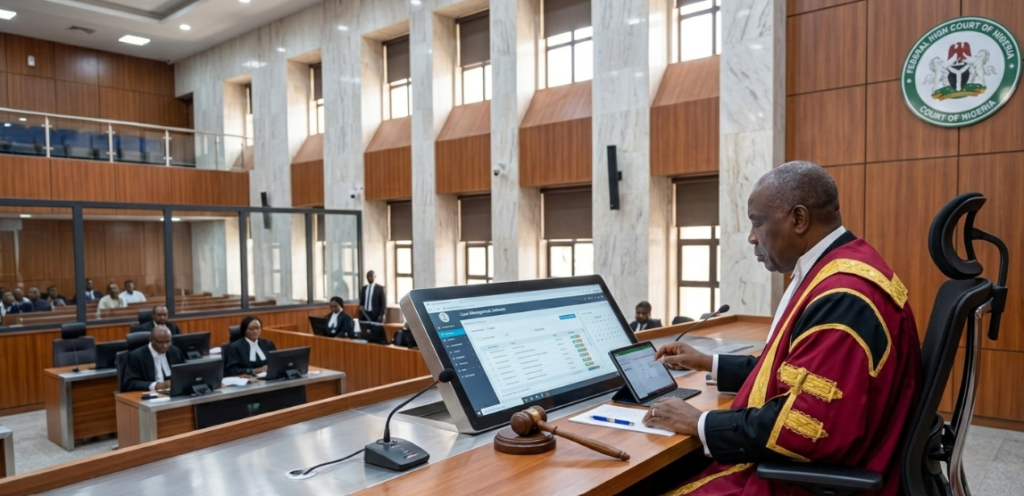
The Federal High Court of Nigeria formally launched its Electronic Filing (E-Filing) System in the Lagos Division, marking a major shift from manual, paper-based procedures to a digital case management platform designed to improve efficiency, transparency, and accountability in judicial administration. ThisDayLive
The platform powering this is the Nigerian Case Management System (NCMS). The NCMS enables cases to be filed online, managed digitally, and transmitted seamlessly across appellate levels.
This is not a small pilot. It is being positioned as the foundational infrastructure for courts across Nigeria.
Shift 2: Digital Court Records and Case Tracking
One of the least glamorous but most important changes is what happens to a case file once it enters the system.
The system automatically generates verifiable digital records for every filing, creating an audit trail that eliminates backdating of processes and reduces the influence of corrupt intermediaries.
Think about what that means. Every document is timestamped. Every step leaves a trace. The culture of “missing files” that has plagued Nigerian courts for decades becomes structurally harder to sustain when every movement is logged.
Shift 3: Electronic Affidavits
Before 2024, deponents had to physically appear before a Commissioner for Oaths to swear affidavits; a process that was time-consuming and logistically burdensome, especially for people outside major cities.
The E-Affidavit Client Portal is a secure, web-based platform designed to digitize and simplify the affidavit deposition process, featuring online affidavit submission, real-time tracking, secure payments, and digital notarization.
The Practice Direction allowing litigants to depose to affidavits electronically at the Federal High Court came into effect on 1 July 2024, issued by the Chief Judge pursuant to Orders 57 and 58 of the Federal High Court Civil Procedure Rules 2019.
This single reform has saved countless hours for both lawyers and their clients.
Shift 4: Virtual Hearings and Remote Participation
The pandemic accelerated virtual hearings across the world, and Nigeria was no exception. What began as an emergency measure has since become a recognized part of Nigeria’s evolving judicial landscape.
The Chief Justice of Nigeria, Kudirat Kekere-Ekun, described digitisation as a core priority for the judiciary, adding that virtual hearings, e-filing, and electronic case tracking represent a deliberate shift toward transparency, order, and user-centred court administration.
She explained that the growing complexity of cases, including technology-driven crimes and cross-border commercial disputes, requires new skills, firmer case management, and rapid judicial adaptation.
For businesses with commercial disputes that cross state or national boundaries, virtual hearings remove one of the biggest logistical headaches in litigation.
Shift 5: AI-Powered Tools for Legal Research and Case Management
This is the frontier that is generating the most discussion in Nigerian legal circles.
Startups and legacy legal-tech vendors have been quick to respond to the digital push. Homegrown platforms offering case-management dashboards, automated docketing, and even AI search for precedent have proliferated in 2024, 2025 and 2026.
Efforts are being made to significantly increase the usage of emerging technologies, with responsible artificial intelligence at the forefront of potential solutions to the judiciary’s increasing caseload.
The applications being explored include intelligent case scheduling, automated document handling, transcription services, and AI-assisted legal research tools that help judges and practitioners navigate precedents faster.
What the Chief Justice of Nigeria Says About AI in Courts
It would be easy to assume that the judiciary’s leadership is resistant to technology. The reality in Nigeria is more nuanced and more encouraging than that.
The Chief Justice of Nigeria, Justice Kudirat Kekere-Ekun, said that while artificial intelligence holds immense potential for improving justice delivery, its deployment in the Nigerian judiciary must be approached with caution and guided by strong ethical and legal frameworks.
Her position is clear-eyed. She is not opposed to AI; she is insisting that it be deployed responsibly.
According to the CJN, though the integration of AI into Nigerian courts is still at an early stage, private legal technology firms like Law Pavilion and publishers of the Nigeria Weekly Law Reports have already developed software that enables electronic access to legal reports, precedents, and forms. Punch
The CJN has also committed the National Judicial Council to action. The NJC, under her leadership, is committed to working with state judiciaries and other stakeholders to standardise digital protocols, harmonise technology platforms, and ensure interoperability across jurisdictions.
That commitment to interoperability is significant. One of the persistent problems with digital reform in Nigerian institutions has been fragmentation; different agencies building different systems that cannot speak to each other. The NJC’s stated intent to harmonize platforms is exactly the kind of coordination that will determine whether Nigeria’s judiciary transformation succeeds at scale.
The Challenges That Still Exist
An honest assessment of Nigerian judiciary digital transformation must include what is not working yet.
Infrastructure gaps: Not every court in Nigeria has reliable internet connectivity or the hardware to support digital systems. The reforms are currently concentrated in Lagos and Abuja. Most state courts are still operating manual systems.
Digital literacy: These are not speculative leaps; they are incremental process improvements that reduce idle time in court calendars. But efficiency gains come with downsides that are structural, not merely technical. Many practitioners, particularly senior lawyers who built their careers on paper-based processes, face a genuine learning curve.
Algorithmic bias: Nigeria has the opportunity to lead AI’s transformation while ensuring that technology serves justice rather than replacing human judgment. If AI tools used in case management are trained on historical data that reflects past systemic biases, they risk encoding those biases into automated decisions.
Funding and sustainability: Technology requires maintenance, updates, and long-term investment. The question of who funds the ongoing development of platforms like the NCMS, and how they remain current, is one that has not been fully answered.
None of these challenges makes the transformation impossible. They simply remind us that technology is not a magic solution; it is a tool whose value depends entirely on the institutional will and resources behind it.

What This Means for Lawyers, Businesses, and Everyday Nigerians
The Nigerian judiciary digital transformation is not just a story about courts and technology. It is a story about access.
For lawyers: The practice of law is changing. Remote filing, digital case tracking, and AI-assisted legal research are not optional extras; they are becoming core competencies. Practitioners who adapt early will serve their clients better and operate more efficiently.
For businesses: The new e-filing system is designed to address persistent issues such as slow procedures, lost documents, and limited transparency in case management. For companies in regulated industries; banking, telecoms, oil and gas; faster, more transparent court processes reduce the cost and uncertainty of legal disputes.
For everyday Nigerians: The transformation is most meaningful when it translates to access. When a person in Enugu can file an affidavit without traveling to Lagos. When a small business owner in Kano can track a commercial dispute without relying entirely on a lawyer’s verbal updates. When the legal system becomes something that ordinary people can navigate with some degree of independence.
That vision is still being built. But the direction is right.
How Lexark Fits Into Nigeria’s Legal Future
As Nigeria’s courts go digital, one critical challenge remains: most Nigerians still do not know which law applies to their situation or where to find it.
Lexark is designed to close exactly that gap. It is a Nigerian AI-powered legal intelligence platform that makes Nigerian laws, statutes, and regulations searchable and accessible for lawyers, businesses, and citizens alike.
In a world where courts are digitizing their processes, Lexark ensures that the legal knowledge needed to navigate those processes is equally accessible. You should not have to be a senior partner at a law firm to understand your rights under Nigerian law.
Whether you are a compliance officer tracking regulatory changes, a lawyer preparing for a digital filing, or an entrepreneur trying to understand what the law says about your industry, Lexark puts that information in your hands in seconds.
Stay updated on Nigeria’s evolving legal tech landscape by following Lexark on Instagram.

Conclusion
Nigeria’s judiciary digital transformation is not a headline; it is a movement that is quietly reshaping how justice is delivered in one of Africa’s most complex legal environments. The e-filing launch, virtual hearings, digital case records, and AI-assisted tools are not experiments anymore. They are infrastructure.
The shifts we have covered here; from the NCMS platform to the CJN’s commitment to standardized digital protocols; point toward a judiciary that is becoming more efficient, more transparent, and more accessible with each passing year.
The legal system is changing. The only question is whether you are positioning yourself to take advantage of it.
Your next step starts with being informed. Visit lexark.org today and access the Nigerian laws and regulations that affect you instantly.