

Table of Contents
AI tools for lawyers in Nigeria are software platforms; some general-purpose, some built specifically for Nigerian law; that use artificial intelligence to speed up legal research, draft documents, review contracts, and manage case files. In practice, this means a lawyer in Lagos or Abuja can now find a relevant Supreme Court judgment in seconds instead of hours, or get a first draft of a legal letter in minutes instead of an afternoon. The rest of this article walks through what these tools actually do, which ones Nigerian lawyers are using in 2026, and how to pick one that fits your practice.
What Are AI Tools for Lawyers in Nigeria?
At their core, these tools fall into a few broad categories: legal research assistants, document drafting tools, contract review software, and case or practice management systems with AI built in. Some, like LawPavilion, were designed specifically around Nigerian statutes, case law, and court practice. Others, like ChatGPT and Claude, are general-purpose AI assistants that lawyers have adapted for legal work.
What ties them together is a shared promise: less time spent on repetitive, manual tasks, and more time spent on the strategic thinking that actually needs a trained legal mind. That said, none of these tools replace legal judgment; they support it.

Why Nigerian Lawyers Are Adopting AI Tools Faster Than Ever
Nigeria’s legal environment has always been demanding. Lawyers often deal with scattered case law, statutes spread across multiple gazettes, and courts that are still transitioning to digital filing. This fragmentation is exactly why AI-powered legal tools have found such fast adoption among Nigerian practitioners over the past two years.
At the 2026 Nigerian Bar Association Law Week in Lagos, discussions centred on whether AI represents a threat or a genuine opportunity for the profession, alongside hands-on sessions to help lawyers build real digital skills rather than just talk about them in theory (Punch, 2026). Around the same period, senior lawyers speaking at NBA events in other branches noted that legal practice has moved well past the “future prediction” stage; platforms like LawPavilion are now a normal part of how Nigerian lawyers do research, and courts in several states have already introduced e-filing and virtual hearings.
This mirrors what we cover in more detail in Nigerian Judiciary Digital Transformation, where court digitisation and AI adoption are shown to be moving hand in hand rather than as separate trends. It also connects to the broader shift explored in Legal Tech Trends in Nigeria, which looks beyond individual tools at how the entire profession is changing.
A few forces are driving this shift:
- Time pressure. Manual research through physical law reports can take hours; AI search tools cut that down to minutes.
- Client expectations. Corporate clients increasingly expect faster turnaround on contracts and opinions.
- Court digitisation. As Nigerian courts modernise, lawyers who are comfortable with digital tools have a real edge.
- Competitive pressure. Younger lawyers entering the profession are often digital-first, pushing firms to keep pace.
None of this means paper and tradition are disappearing overnight. It means the lawyers who blend solid legal training with smart use of technology are pulling ahead.
9 AI Tools for Lawyers in Nigeria Worth Exploring
There is no single “best” tool; the right choice depends on your practice area, budget, and how much of your work involves Nigerian-specific law versus general drafting and analysis. Here are nine standout options worth knowing about in 2026. For a deeper comparison of research-specific platforms, our earlier piece on Best Legal Research Tools for Nigerian Lawyers is a useful companion read.
1. LawPavilion. Built specifically around Nigerian legal authorities, statutes, and judicial decisions, this remains one of the most recognised names in Nigerian legal tech. It is particularly useful for litigation lawyers who need quick access to case law and precedent.
2. Case Radar. A research-focused platform tailored to help lawyers track and locate Nigerian case law more efficiently than manual search.
3. Legalpedia. Offers access to recent Nigerian cases, statutes, and a legal dictionary, with note-taking and networking features built in.
4. ChatGPT. A general-purpose AI assistant widely used by Nigerian lawyers for drafting correspondence, summarising documents, and brainstorming arguments. It is flexible, but every output still needs to be checked against verified Nigerian sources.
5. Claude. Known for handling very long documents accurately, Claude is useful for lawyers who need to review lengthy contracts, policy documents, or discovery bundles in one pass.
6. Microsoft Copilot. For lawyers already working inside Word, Excel, and Outlook, Copilot drafts documents, builds spreadsheets for billing or case tracking, and summarises long email threads without leaving the Microsoft ecosystem.
7. Lexis+ AI. Combines a large legal database with a natural-language search interface, letting lawyers ask plain-English questions and receive analysed, sourced answers.
8. Nexis+ AI. Another research-oriented AI platform gaining traction among African legal teams for faster case and statute lookups.
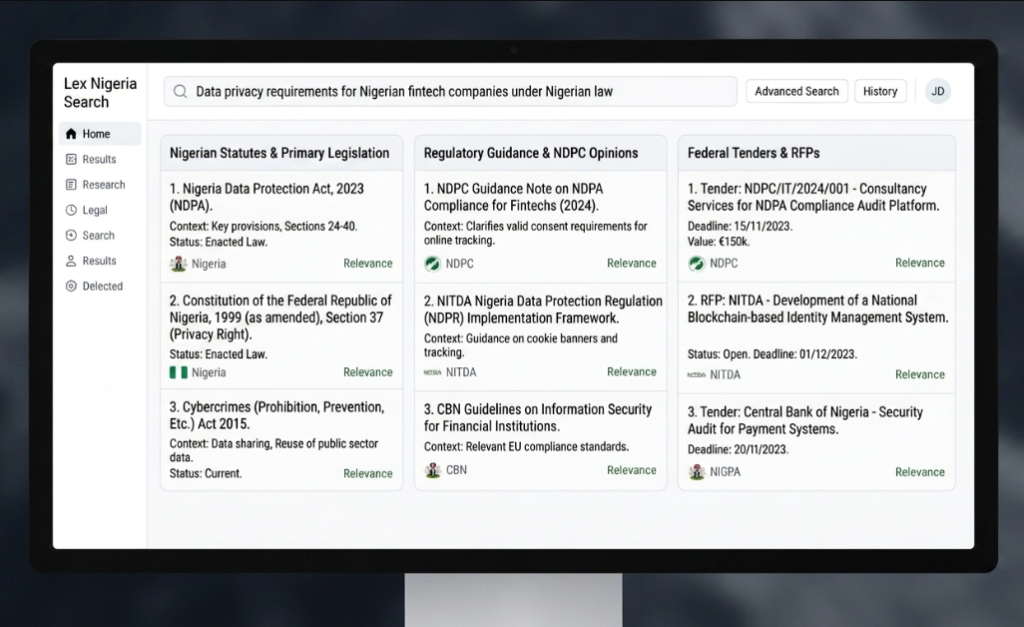
9. AI-assisted legal research platforms built for Nigeria (like Lexark). Beyond global tools, Nigeria now has homegrown platforms that bring laws, regulations, and even government tender data into one searchable place, which is especially useful for lawyers who also advise clients on regulatory or procurement matters.

How to Choose the Right AI Tool for Your Practice
With so many options now available, choosing one can feel overwhelming. A few practical questions can help you narrow the list quickly.
First, ask what your biggest time drain actually is. If it’s research, prioritise a tool built around Nigerian case law and statutes. If it’s document drafting, a general AI assistant with strong writing capabilities may serve you better.
Second, consider data sensitivity. Client confidentiality is non-negotiable, so check how a tool stores and processes data before uploading sensitive case files. This is one reason many firms pair a general AI assistant with a dedicated legal practice management platform that keeps client records, billing, and correspondence in one secure system.
Third, think about cost versus firm size. Solo practitioners and small firms often benefit from tools with flexible, pay-as-you-go pricing, while larger firms may find more value in enterprise platforms with team-wide access.
Fourth, look at how easily a tool fits into tasks you already do daily, such as automating routine legal research or preparing first drafts of common documents. A tool that requires you to change your entire workflow is far less likely to stick.
Finally, test before you commit. Most reputable platforms, including Nigerian-focused ones, offer free trials or limited free tiers. Use that window to see how the tool performs on real, everyday tasks from your own practice, rather than relying on marketing claims alone.
Risks Every Lawyer Should Understand Before Relying on AI
AI tools are powerful, but they are not infallible, and Nigerian lawyers should approach them with the same caution they would apply to any new research source. Global industry reports on legal technology note that this is exactly the balance the profession is now working through, weighing genuine productivity gains against the need for careful verification (Darrow, 2026).
The most talked-about risk is “hallucination,” where a general-purpose AI tool generates a confident-sounding answer, complete with citations, that turns out to be inaccurate or entirely fabricated. This is a genuine concern with tools like ChatGPT and Claude when they are not connected to verified legal databases. The safest practice is to treat any AI-generated citation as a starting point, not a final answer, and to confirm it against a primary source, such as the official statute text or gazette, before using it in a filing.
Confidentiality is another concern. Uploading client documents into a general AI tool without understanding its data policies can create real professional risk. Always check whether a platform is built with legal-grade security and confidentiality standards in mind, and read the terms of service before uploading anything sensitive.
There is also a practical accuracy gap to consider. General AI models are trained on global data, and Nigerian law, with its mix of statutes, case law, and evolving regulations, is a relatively small slice of that data. A tool built specifically around Nigerian legal sources will usually be more reliable for local research than a general-purpose chatbot, even a very capable one.
Finally, over-reliance is a quieter risk. AI can draft, summarise, and search, but it cannot replace the judgment, ethics, and advocacy skills that define good lawyering. The tools work best as an assistant, not a substitute; the lawyer remains fully responsible for what goes into a client’s file or a court filing.
Where Platforms Like Lexark Fit Into the Picture
Part of what makes Nigeria’s legal landscape hard to navigate is that laws, regulations, and even government tenders are often scattered across different portals and physical records. This is the specific gap that platforms like Lexark are built to close, by bringing Nigerian laws, regulations, and AI-assisted research into a single searchable place.
For lawyers, that means less time spent hunting for a statute or regulation and more time spent applying it. For compliance officers and businesses in regulated sectors, it means an easier way to stay current as rules change. It is not a replacement for legal expertise; it is infrastructure that makes legal expertise easier to apply quickly and confidently.
A Simple Checklist to Get Started
If you are new to AI-assisted legal work, here is a straightforward way to begin:
- Pick one repetitive task (research, drafting, or summarising) to test first.
- Choose a tool suited to that specific task, rather than trying to do everything with one platform.
- Verify every AI-generated fact or citation against a primary source before relying on it.
- Confirm the platform’s data and confidentiality policy before uploading client material.
- Review results critically; treat AI output as a first draft, not a final one.
- Expand gradually into other tasks once you’re comfortable with the tool’s strengths and limits.
Are AI tools for lawyers in Nigeria reliable for legal research?
They can significantly speed up research, especially platforms built around Nigerian case law and statutes. However, output should always be verified against primary legal sources before being relied upon in practice.
Do I need technical skills to use these tools?
Most modern AI legal tools are designed with simple, everyday interfaces. Basic computer literacy is usually enough to get started.
Is it ethical to use AI in legal practice?
Yes, provided the lawyer remains responsible for verifying accuracy, protecting client confidentiality, and using the tool to support, not replace, professional judgment.
Can law students and NYSC lawyers use these tools too?
Absolutely. Many platforms offer discounted or free tiers for students, and building comfort with AI-assisted research early is quickly becoming a practical career advantage.
Final Thoughts
Nigeria’s legal profession is clearly moving in one direction: toward smarter, faster, technology-assisted practice. The lawyers thriving in this shift are not the ones who chase every new tool; they are the ones who understand their own workflow well enough to know exactly where AI can help. So the real question is not whether you should explore AI tools for lawyers in Nigeria; it’s which one fits the way you already work?