
Table of Contents
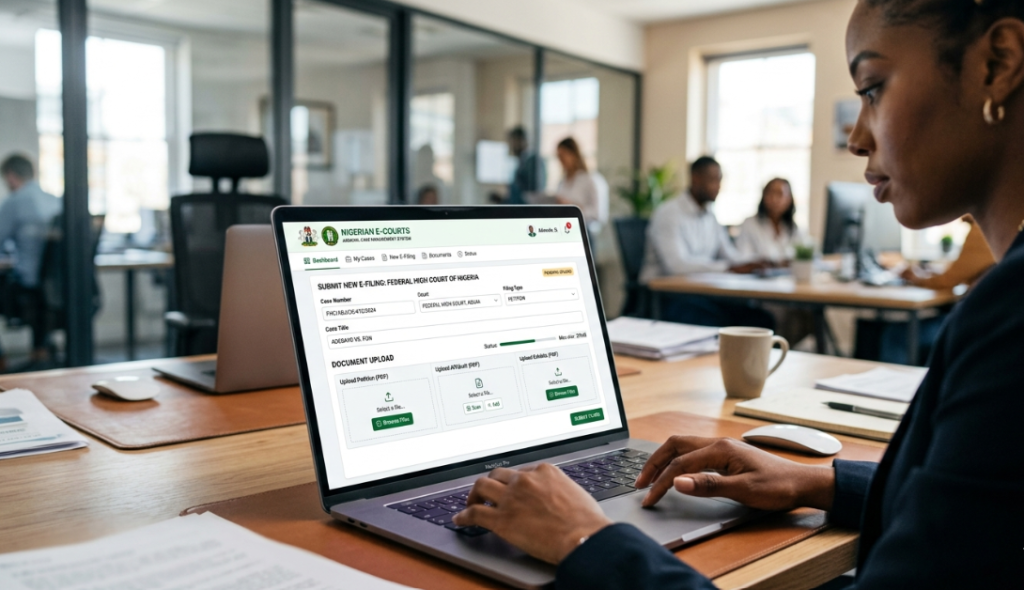
The digital court filing system Nigeria, known as the Nigeria Case Management System (NCMS) and operating through the e-filing portal at efiling.courts.gov.ng, allows lawyers and litigants to submit court processes electronically from anywhere, at any time. The Federal High Court formally launched its e-filing system in Lagos in April 2026, ending paper-based court filing procedures. Lawyers can now file documents, pay filing fees online, and receive verifiable digital records of every submission.
Why This Change Was Overdue
For decades, filing a court process in Nigeria meant physically walking into a court registry. It meant waiting in long queues. It meant dealing with registry staff who sometimes worked at their own pace and within very rigid office hours.
It meant paper; mountains of it. And for a court system already managing hundreds of thousands of pending cases, paper was quietly choking the administration of justice.
At the end of the 2023/2024 legal year, 161,999 cases were pending and carried forward. During the following period, 19,925 new cases were filed, bringing the total pending cases to 181,924. Of those, only a fraction were resolved before the year ended.
That is not the image of a justice system thriving under its current model. It is the image of a system that was crying out for structural change. And in April 2026, that change finally arrived in a significant way with the formal launch of the digital court filing system in Nigeria.
What Is Nigeria’s Digital Court Filing System?
The digital court filing system in Nigeria is a technology platform designed to allow lawyers, litigants, and court users to submit legal processes electronically, without needing to visit a court registry in person.
The system is called the Nigeria Case Management System (NCMS); a digital infrastructure supporting electronic filing and case tracking across superior courts. It was developed under the Judicial Information Technology Policy framework and is overseen by the Judicial Information Technology Policy Committee (JITPOCOM) of the National Judicial Council.
The platform was formally unveiled in Lagos in April 2026 when the Federal High Court launched its own electronic filing (e-filing) module; one of the most visible deployments of the NCMS so far.
The Federal High Court Chief Judge, John Terhemba Tsoho, declared the judiciary was ending what he described as the “era of paper antiquity,” marking a decisive shift from manual, paper-based procedures to a digital case management platform designed to improve efficiency, transparency, and accountability.
The e-filing portal for the Federal High Court is accessible at efiling.courts.gov.ng, where registered users can submit processes online.

7 Things Every Nigerian Lawyer Must Know About E-Filing
1. You Can Now File from Anywhere, at Any Time
This is perhaps the most immediately practical change. The removal of registry working-hour limitations means lawyers and litigants can now file processes at any time and from any location with internet access.
If you finish drafting a motion at 11 PM, you can file it that night. If you are in Abuja but your matter is in the Lagos Division of the Federal High Court, you no longer need to travel or instruct a Lagos agent simply to file a document.
2. Every Filing Creates a Verifiable Digital Record
One of the most important features of the new system is its built-in accountability mechanism. The system automatically generates verifiable digital records for every filing, creating an audit trail that eliminates backdating of processes and reduces the influence of unofficial intermediaries in court registries.
This is significant for any lawyer who has ever faced a situation where a filed process mysteriously could not be found in the registry. With the digital system, every submission is timestamped and traceable.
3. Filing Fees Are Now Paid Electronically
One of the pain points of the old system was making physical payments at designated banks or paying agents before a process could be filed. The new system integrates electronic payment channels for filing fees, ensuring instant and transparent revenue collection while reducing financial leakages.
This means faster filing, cleaner financial records, and less opportunity for informal payment arrangements that have long undermined court administration.
4. Hard Copies Are Still Required for Now; But Not Forever
The transition is gradual. While hard copies are still required for initial service under current rules, senior lawyers were advised to delegate filing tasks to junior counsel or IT staff during the adjustment period.
This is important context. Digital filing does not mean paperless overnight. Your firm should prepare for a hybrid process while the rules catch up with the technology.
5. The System Is Part of a Nationwide Rollout
The Lagos launch is not an isolated event. The NCMS is designed to create a unified judicial ecosystem where cases can be filed, managed, and transferred electronically across courts nationwide. What started in Lagos is meant to expand to every superior court in the federation.
For Nigerian lawyers with practices spanning multiple states, this will eventually mean one consistent digital filing process across all jurisdictions.
6. AI Pilot Tools Are Already Being Tested Within the Judiciary
The e-filing launch was not the only technology development announced. Pilot use of artificial intelligence tools within the judiciary has shown promising results in reducing the workload involved in legal research and judgment preparation, though the technology remains experimental.
This signals that the direction of travel for Nigeria’s judicial system is firmly toward technology integration; and that lawyers who are already comfortable with AI-assisted research will have a smoother transition as the courts become more digital.
7. The NBA Has Endorsed the Move
Some lawyers worry that new technology is being imposed without adequate consultation. That is not the picture that emerged from the Lagos launch. The Nigerian Bar Association, represented at the launch, expressed strong support for the initiative, noting that technology adoption is essential to maintaining Lagos as a centre of legal excellence and improving service delivery.
This institutional endorsement matters. It signals that the profession, at the representative level, is aligned with the direction the judiciary is taking.
How the Anti-Corruption Features Work
One aspect of the digital court filing system in Nigeria that deserves deeper attention is how it is designed to reduce corruption in court registries.
The old paper-based system had gaps that were well understood. Documents could be pulled, reordered, or selectively held back. Dates could be altered. Unofficial payments sometimes determined how quickly a process was processed.
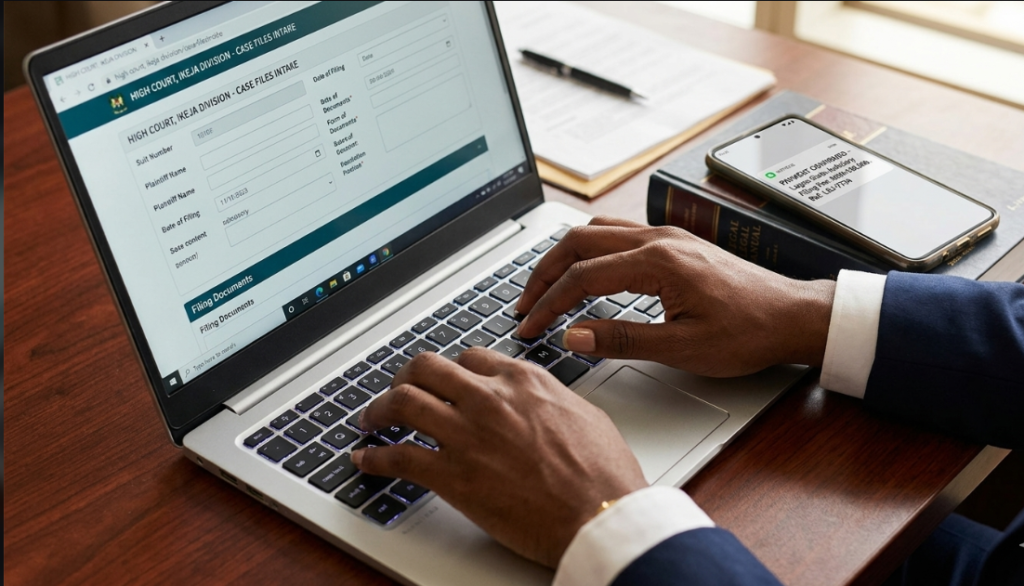
The e-filing system changes this by removing human discretion from the filing process itself. When you submit a process electronically, the system assigns it a timestamp immediately. That timestamp is recorded on the server and visible to multiple parties. No one can backdate it. No one can deny it was received.
The new platform closes loopholes that have been exploited in the past; the e-filing system leaves a digital footprint, prevents backdating, and facilitates real-time tracking of filed motions.
Additionally, because filing fees are paid through integrated electronic payment channels, the opportunities for informal cash transactions at registry counters are reduced significantly.
For lawyers who have experienced the frustration of processes being delayed or “lost” in registries, this is a meaningful structural improvement.
What the Shift Means for Access to Justice in Nigeria
Beyond the operational benefits for lawyers and law firms, the digital court filing system in Nigeria carries a deeper significance; access to justice for ordinary Nigerians.
When filing a case required physically visiting a court registry during narrow office hours, the legal system was structurally biased toward people who had the time, mobility, and resources to do so. People in remote areas, people with disabilities, business owners who could not leave their operations; all of them faced a higher barrier to engaging with the court system.
Automated case processing, payment systems, and communication tools have been implemented through this online court system, enabling timely access to case-related information for all parties.
That is a shift with real human consequences. When justice becomes more accessible, more people can use the legal system to enforce their rights; and that has downstream effects on everything from contract enforcement to property disputes to human rights claims.
Understanding this broader context is important for lawyers too. The more accessible the court system becomes, the more people will seek legal representation. That is potentially good for legal practice in Nigeria.
For more on how the Nigerian judiciary is evolving digitally, the Lexark blog on the Nigerian judiciary’s digital transformation covers this in depth.
You can also read the Lexark guide on how to file a court case online in Nigeria for a practical step-by-step breakdown.
Challenges to Expect During the Transition Period
Acknowledging the challenges of this shift is just as important as celebrating the progress. Nigerian lawyers and law firms should be realistic about the obstacles ahead.
Internet reliability: Filing online requires stable internet access. In some states, connectivity remains inconsistent. Lawyers should have backup internet options available on days when important filings are due.
Staff training: Not every member of a law firm’s team is equally comfortable with digital platforms. Training administrative staff and junior associates on how the e-filing portal works is a practical necessity, not an optional upgrade.
Varying court readiness: The Lagos Division of the Federal High Court is now live. But not every court in Nigeria is at the same stage. Lawyers will need to stay updated on which courts are using the NCMS and which are still using paper-based processes.
Technical errors: Any digital system will occasionally experience downtime. Having a contingency plan for technical failures on filing deadlines is something every firm needs to think through.
Rule updates: The Civil Procedure Rules governing filing in various courts were written for a paper world. As the courts update those rules to reflect digital processes, lawyers need to stay current.
For a detailed breakdown of how the filing process currently works, the Lexark article on the court filing process in Nigeria is a practical reference.

How to Prepare Your Law Firm for Digital Filing
Given where Nigeria’s courts are heading, preparation is not optional. Here is what law firms should be doing right now:
Register on the e-filing portal. The Federal High Court’s e-filing system is already live. Your firm should have accounts created and tested before you need to file something urgent.
Train your team. Identify who in your firm handles court filings and make sure they understand the new process. Run at least one practice submission before the real thing.
Upgrade your document management. Digital filing works best when your internal document workflow is also digital. If your drafting and review process is still paper-based, the efficiency gains at the filing stage will be limited.
Integrate AI research tools. As courts digitize, lawyers who use AI-assisted legal research tools will be faster and more competitive. Platforms like Lexark allow Nigerian lawyers to search laws, regulations, and cases instantly; cutting the research time that currently consumes billable hours.
Monitor rule updates. The rules governing e-filing are evolving. Subscribe to Nigerian Bar Association updates, follow the National Judicial Council’s announcements, and keep an eye on platforms like Lexark’s blog on best legal research tools for Nigerian lawyers for practical guidance.
Stay updated with @lexarklegal on Instagram for the latest on legal technology developments in Nigeria.
For a broader perspective on where global legal practice technology is heading, the ABA’s analysis of law firm transformation challenges is a solid external reference.
Conclusion
Nigeria’s digital court filing system is not a future concept; it is live, it is expanding, and it is changing how legal practice works in this country.
The lawyers and firms that treat this moment as the noise of someone else’s concern will find themselves playing catch-up in a system that is moving on without them. The ones who prepare now; who train their teams, register on the platforms, and integrate digital tools into their practice; will be the ones who serve clients better, file faster, and operate with less friction.
The Nigerian judiciary has declared the era of paper antiquity over. The only question left for you is this: when clients begin to expect faster filings, real-time updates, and professional digital service from their lawyers, will your firm already be ready to deliver; or will you still be looking for the right file cabinet?
The time to prepare is not when the transition is complete. It is right now.