

Table of Contents
Online legal resources for law students are digital platforms, from official government sites to AI-assisted research tools, that give students free or affordable access to Nigerian statutes, case law, and study notes without needing to buy every textbook or travel to a physical law library. The best ones combine reliable, verified legal content with a search experience that actually works. Below is a practical guide to seven of the strongest options available to Nigerian law students right now, plus how to use them well.
What Are Online Legal Resources for Law Students?
For decades, Nigerian law students relied almost entirely on physical textbooks, photocopied lecture notes, and whatever case reports their faculty library could afford to stock. That model is changing fast. Today’s digital study platforms span several categories: government legislative portals, academic research guides, case-law databases, revision-note repositories, and AI-assisted legal research tools.
What makes a resource genuinely useful is not just how much content it holds, but how easy it is to search, how current the information is, and whether it’s written in a way students can actually understand under exam pressure. This is closely related to a point we explored in Nigerian Legal Regulations Database, which looks at how scattered Nigeria’s regulatory information can be, even for working professionals, let alone students still learning to navigate it.
It’s also worth understanding what these platforms are not. They are not a substitute for reading assigned cases in full, and they are not a shortcut around understanding legal reasoning. Used well, they simply remove the friction of finding material in the first place, so more of your study time goes toward actually understanding it.

Why Every Nigerian Law Student Needs a Digital Research Toolkit
Nigerian legal education covers an enormous amount of ground, from constitutional law and torts to company law and evidence, often within a single semester. Building a habit of using solid digital research tools early can make the difference between drowning in reading lists and actually understanding the material.
There are practical reasons this matters more than ever:
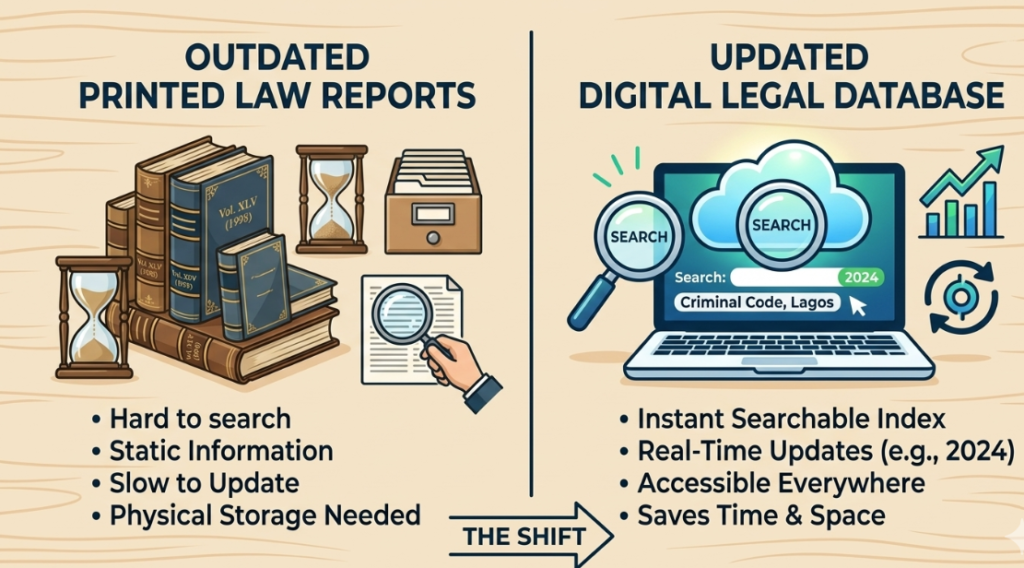
- Case law changes. Judgments are decided regularly, and printed casebooks can quickly go out of date, while digital platforms are usually updated much faster.
- Cost. Many official law reports and textbooks are expensive; digital and freemium resources widen access considerably, which matters for students managing tight budgets.
- Exam and Bar preparation. Nigerian Law School and university exams reward students who can locate and apply the right authority quickly, a skill best built through regular digital research practice rather than cramming the week before finals.
- Career readiness. Law firms increasingly expect graduates to already be comfortable with legal research software, not just paper reports, so students who build this habit early enter practice with a real advantage. Firms are also actively automating legal research internally, which means graduates who already understand digital research tools tend to settle into practice faster.
- Access beyond the classroom. Not every student has equal access to a well-stocked faculty library, particularly outside major cities, and online platforms help close that gap.
None of this replaces reading primary texts closely or attending lectures. It simply means students today have far more support available than previous generations did, and there is little reason not to use it.
7 Online Legal Resources for Law Students in Nigeria
Here are seven platforms and resource types worth bookmarking, ranging from free government sources to AI-assisted research tools. Several of these also come up in our broader look at Legal Tech Trends in Nigeria, which covers how the profession as a whole, not just students, is shifting toward digital-first research.
1. The National Assembly website. The primary source for Nigerian federal legislation, including bills and Acts as they are passed. It’s not the most polished interface, but it is the authoritative starting point for statutory research.
2. Library of Congress, Guide to Law Online: Nigeria. A carefully curated, free research guide covering Nigeria’s constitution, legislative branch, judiciary, and general legal sources, compiled by professional law librarians. It is an excellent starting point for students who are not yet sure where to look.
3. Nigerian Law Guru. A dedicated online resource centre built specifically to support legal scholars, practitioners, and students researching Nigerian law, with articles and case commentary organised by topic.
4. LegalDigitalNG. Offers Supreme Court judgments, expert legal analyses, and a dedicated student module with curated Nigerian Law School revision notes, useful for exam preparation as well as general research.
5. Learn Nigerian Law. A notes-based platform that explains Nigerian legal topics in plain, exam-friendly language, useful for students who want a simplified first pass before tackling denser case reports.
6. NWLR Online (Nigerian Weekly Law Reports). The digital home of one of Nigeria’s most respected law report series, now searchable online alongside statutes and court rules.
7. AI-assisted legal research platforms (like Lexark). Newer Nigerian platforms now bring laws, regulations, and case material into one searchable interface with AI-powered search, helping students find relevant material by simply describing what they’re looking for in plain language rather than knowing the exact citation in advance.

How to Use These Resources Without Getting Overwhelmed
Having access to seven different platforms doesn’t help much if you don’t know how to use them efficiently. A few simple habits go a long way.
Start with one primary source per task. If you’re researching a statute, go straight to the National Assembly site or a regulations database rather than starting with a general web search. If you’re researching case law, go to a dedicated case-law platform first.
Use plain-language searches when a platform supports AI-assisted search. Instead of guessing the exact legal terminology, describe the issue in your own words; modern research tools are increasingly built to understand natural language questions, not just exact keyword matches.
Keep a simple running log of sources as you go, including the full citation. This single habit saves hours later when you’re writing assignments or preparing for oral exams and need to reference where a point came from.
Cross-check anything AI-generated. If a tool summarises a case or suggests an argument, verify it against the primary judgment or statute before quoting it in an assignment. This is good academic practice and also builds the verification habit you’ll need throughout your legal career.
It also helps to understand how court processes are changing alongside research tools. Reading up on developments like how to file a court case online in Nigeria gives useful context on where the profession is heading, and how the research skills you’re building now connect to real practice later.
Common Mistakes Law Students Make With Online Research
A few patterns show up again and again among students who struggle to get value from online research, even when they’re using good platforms.
The first is relying on a single, unverified website found through a general search engine, without checking whether the source is current or authoritative. Not every legal blog or forum post reflects the current state of the law.
The second is treating research as a one-time task rather than an ongoing habit. Law is not static; regulations and case law shift, and students who only research once at the start of a course often work from outdated material by exam time.
The third is skipping primary sources entirely in favour of secondary summaries. Notes and commentary are useful for building understanding, but examiners and, later, courts expect you to engage with the actual statute or judgment, not just someone else’s summary of it.
Building Research Habits That Outlast Law School
The students who get the most out of these digital study tools are usually the ones who treat research skills as something to build deliberately, not something that just happens by accident.
A simple weekly habit works well: pick one legal topic from your coursework, and instead of only reading the assigned textbook chapter, spend twenty minutes searching for how that area of law has been applied or discussed recently. Over a semester, this small habit compounds into genuine research fluency, the kind that Nigerian Law School and, later, practice will reward.
It also helps to diversify your sources deliberately. Relying on just one platform, however good, means missing perspectives or updates that a second source might catch. Rotating between a government portal, a case-law database, and an AI-assisted research tool gives a more complete picture than any single resource alone.
Are online legal resources for law students free in Nigeria?
Many are free or offer a generous free tier, including government portals and research guides. Some premium platforms with advanced search or AI features charge subscription fees, though most offer student-friendly pricing or trial periods.
Can I rely only on AI tools for my law school assignments?
No. AI tools are excellent for speeding up the search process, but assignments and exams require you to engage directly with primary legal texts and demonstrate your own analysis, not just AI-generated summaries.
Which resource is best for exam revision specifically?
Platforms with curated revision notes, such as LegalDigitalNG’s student module or Learn Nigerian Law, tend to work best for exam preparation, while case-law databases are better suited to deeper assignment research.
How do I know if an online legal source is reliable?
Check whether it cites primary sources (the actual statute or judgment), when it was last updated, and whether it’s affiliated with a recognised institution, publisher, or established legal platform.
Final Thoughts
Nigerian law students today have access to research tools that simply didn’t exist a decade ago, and the ones who learn to use them well tend to move through law school with far less stress than those still relying purely on photocopied notes. Start with one or two platforms from this list, build the habit of verifying what you find, and let your research toolkit grow from there. Your future self, studying for the Bar finals at 11pm, will thank you.