
Table of Contents
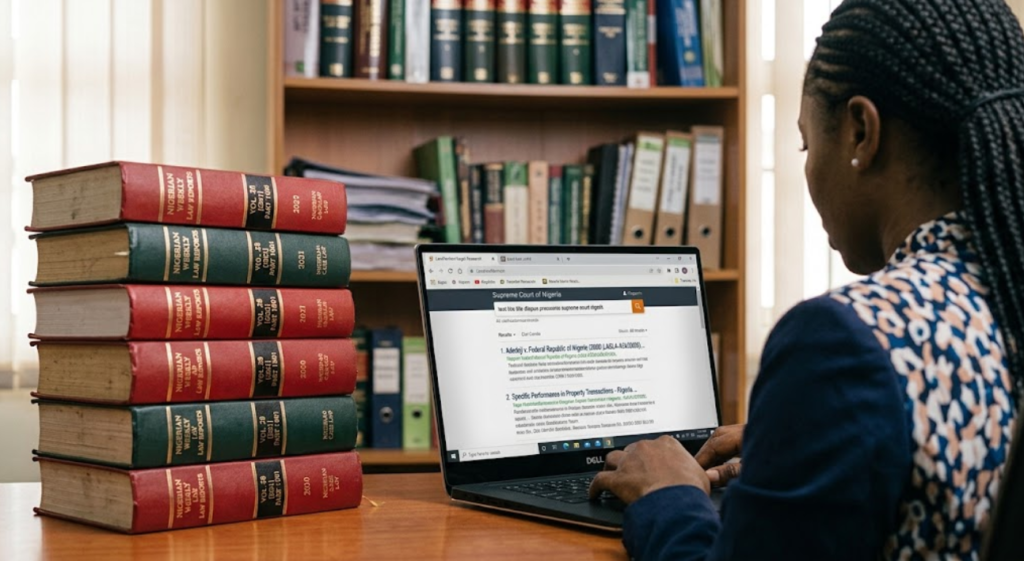
Nigerian law reports online refer to digital collections of judgments from Nigeria’s Supreme Court, Court of Appeal, and other superior courts, published and organised so lawyers, students, and researchers can search case law without combing through physical volumes. The two names that come up most often are NWLR Online (the digital edition of the long-running Nigerian Weekly Law Reports) and LawPavilion’s electronic law report, alongside a handful of free and academic options.
Beyond that summary, the real question most people have is which source actually fits their needs, and how these platforms compare on coverage, cost, and reliability. Let’s go through them.
What Nigerian Law Reports Are, and Why the Move Online Matters
A law report is essentially a curated, annotated collection of court judgments, chosen because they set or clarify a legal principle. In Nigeria, these reports have traditionally been published in print, organised by year and volume, and cited constantly in court filings, academic writing, and legal opinions.
The problem with print-only law reports is obvious once you’ve searched for one specific case buried somewhere across dozens of physical volumes. It’s slow, and it depends entirely on your library actually having the volume you need.
Digitising these reports solves that. A searchable database means you can pull up a judgment by case name, citation, subject matter, or even keyword within the text, in seconds rather than hours. That shift has quietly reshaped how legal research gets done in Nigeria over the past decade or so.
NWLR Online: The Long-Standing Standard
The Nigerian Weekly Law Reports (NWLR) has been publishing judgments since 1985, founded by Chief Gani Fawehinmi with the goal of making Supreme Court and Court of Appeal decisions accessible to every lawyer in the country. It’s widely regarded as Nigeria’s most consistent and authoritative law report series.
NWLR now runs a digital platform, NWLR Online, giving subscribers searchable access to a large archive of judgments, reportedly over 15,000 Supreme Court and Court of Appeal decisions, along with statutes and rules added to the platform over time.
What stands out about NWLR is consistency. It has published weekly for decades without major interruption, which matters a lot for legal citation, since courts and practitioners are used to referencing “NWLR” citations specifically. If you need a source that’s widely recognised and consistently cited in Nigerian courtrooms, NWLR Online is usually the starting point.

LawPavilion: The AI-Era Alternative
LawPavilion’s electronic law reports have grown into one of the most widely used digital legal research tools in Nigeria, and its citations are now regularly accepted in court by judges and referenced by legal scholars.
Where LawPavilion tends to differentiate itself is in tooling built around the reports themselves, things like advanced search filters, citation tools, and features aimed at making research faster for practising lawyers juggling multiple cases at once. Because it launched natively as a digital product rather than migrating from print, its interface and search capabilities are often built with day-to-day legal practice in mind.
For lawyers who want more than a static archive, this kind of platform is worth exploring, especially as AI-assisted legal research tools become more common across Nigerian practice.
Free and Low-Cost Options Worth Knowing
Not everyone needs, or can justify, a paid subscription, especially students and early-career researchers. A few free or lower-cost options exist:
- Government and constitutional documents are often available as free downloads directly from official Nigerian legal resource sites, including foundational texts like the Constitution.
- All Electronic Law Reports (AELR) offers free access to a growing collection of Nigerian judgments, useful as a starting point for less complex research.
- University law libraries frequently maintain subscriptions that students and staff can access through institutional logins, at effectively no direct cost to the individual.
These free options tend to have narrower coverage than the major paid platforms, so they work best as a supplement rather than a sole source, particularly for anything going into a formal legal filing.
Academic and Library Access
Nigerian universities have increasingly built NWLR and similar subscriptions into their law faculty resources. Institutions have publicised subscriptions specifically to give students and staff access to searchable law report databases as part of their academic experience.
If you’re a student, checking with your law faculty library before paying for individual access anywhere else is usually worth the five minutes it takes. Many faculties already have institutional access that covers exactly what you need for coursework and moot court research.
For researchers outside a university setting, some public and professional law libraries also maintain access, so it’s worth asking rather than assuming a subscription is out of reach.
How to Choose the Right Source for Your Needs
There’s no single “best” option here; it depends on what you’re actually doing.
If you’re a practising lawyer citing cases in court, NWLR’s long-established citation format is often the safest default, given how widely recognised it is.
If you want faster search and modern research tools, a platform like LawPavilion, or an AI-assisted legal research tool, may save you significant time, particularly on complex or multi-issue cases.
If you’re a student or doing preliminary research, free resources and your institution’s library access are usually sufficient to get started, with paid platforms reserved for deeper dives later.
If you’re a business or compliance professional who occasionally needs to understand a legal precedent rather than build a full case, a searchable database with plain-language summaries can be more useful than a dense archive of full judgments.
Mistakes That Slow Down Legal Research
A few habits tend to slow people down when searching Nigerian law reports online:
Relying on a single source. Different platforms sometimes have gaps in coverage for older or more obscure judgments, so cross-checking a second source for anything important is good practice.
Searching by case name only. Case names can be common or ambiguous. Searching by citation, subject area, or specific legal principle, when you have that detail, narrows results considerably.
Ignoring citation format. Nigerian courts expect specific citation conventions. A judgment pulled from one database may need reformatting before it’s usable in a formal filing.
Not verifying currency. Legal principles can be affected by later judgments or legislative changes. A report being available online doesn’t automatically mean it reflects the current state of the law; it’s worth checking for more recent authority on the same point.
Where Legal Research Is Headed Next
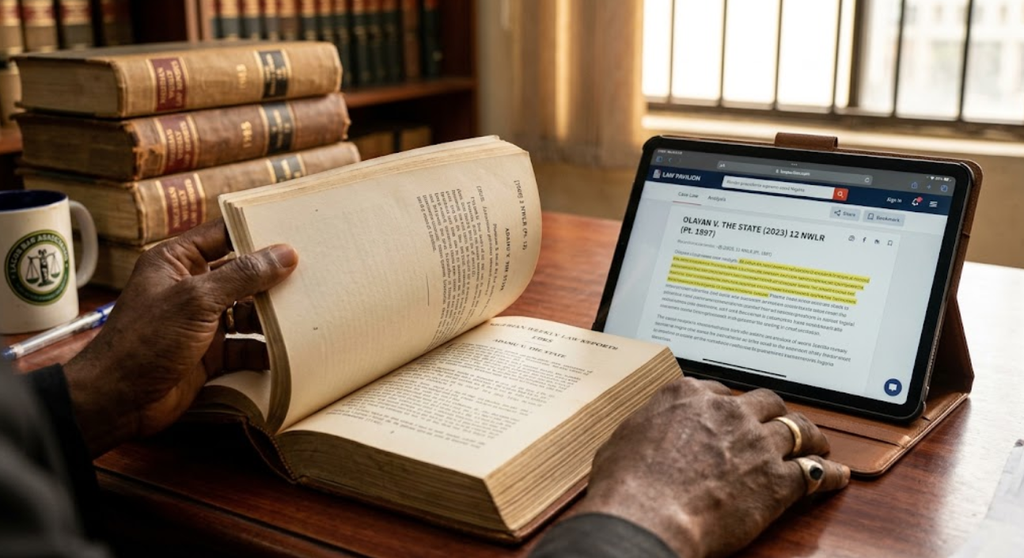
Law reports were once the exclusive domain of well-stocked chambers and university libraries. That’s no longer true. Between subscription platforms, free databases, and AI-assisted research tools, searchable Nigerian case law is genuinely accessible to more people than at any point in the country’s legal history.
If this topic interests you, it’s worth reading further on how AI tools are changing legal research for Nigerian lawyers, or on practical ways to improve legal research efficiency. For a broader list of tools worth having in your research stack, this roundup of legal research tools for Nigerian lawyers is also a useful next stop.
For primary information on NWLR’s own platform and history, see NWLR Online, and for the Supreme Court’s official judgments, the Supreme Court of Nigeria’s website remains the authoritative reference point.
Because the truth is, the researcher who finds the right precedent first usually wins the argument.