

Table of Contents
The future of legal tech in Africa is being written right now, not in some distant decade. Across Nigeria, South Africa, Kenya, and beyond, courts are digitizing case files, lawyers are automating research, and AI-assisted platforms are pulling laws, regulations, and tenders out of scattered filing cabinets and into searchable databases; by 2030, legal work on the continent will look almost nothing like it does today.
If you are a lawyer, a compliance officer, or simply someone trying to understand your rights in Nigeria, this shift affects you directly. Let’s break down exactly what’s changing and why it matters.
What “Legal Tech” Actually Means for Africa
Legal tech is a broad term, and it can feel abstract until you see it in action. In simple terms, it refers to any technology, software, or platform that makes legal work faster, cheaper, or more accessible.
This includes tools for searching laws and case law, software for managing law firm files, AI systems that draft or review documents, and platforms that track government tenders and procurement opportunities. For everyday Nigerians, it also includes tools that translate dense legal language into something a non-lawyer can actually understand.
The future of legal tech in Africa is not just about big law firms buying expensive software. It is increasingly about ordinary people, small business owners, and government agencies all gaining access to legal clarity that used to be locked behind paywalls, physical archives, or professional gatekeeping.
Where Africa’s Legal Systems Stand Today
To understand where things are headed, it helps to understand where they currently stand. For decades, Africa’s legal systems, particularly in Nigeria, have relied heavily on paper. Court files sat in physical registries. Case law was scattered across law reports that were expensive and hard to access. Tender notices were buried inside newspaper classifieds or agency-specific portals that rarely talked to each other.
This fragmentation created real costs. Lawyers spent hours, sometimes days, tracking down a single statute or precedent. Businesses missed lucrative government contracts simply because they never saw the tender notice in time. Compliance officers in regulated industries like banking and oil and gas had to manually monitor dozens of regulatory bodies just to stay current.
A recent analysis of AI regulation across the continent found that artificial intelligence is no longer a future concept in Africa; it is already reshaping regulatory agendas and courtroom practice, driven in large part by the African Union’s Continental AI Strategy, adopted in July 2024, which provides a unified roadmap for AI development across the continent through 2030. That single policy shift has quietly become one of the biggest accelerants behind the future of legal tech in Africa.
Why AI Adoption Is Accelerating Right Now
Three forces are converging at once, and together they explain why 2026 feels like a turning point.
First, judiciaries themselves are digitizing. Nigeria’s courts, for example, are actively phasing out manual filing in favor of electronic systems (we cover this in detail in our companion piece on how courts are digitizing in Nigeria). When the institutions that produce legal information go digital, everything built on top of that information, including AI research tools, becomes dramatically more powerful.
Second, the technology itself has matured. Industry researchers have found that 2025 was the year legal AI moved from being tested to being genuinely used, and 2026 is becoming the year firms decide whether that usage translates into lasting impact. This maturity means legal AI tools are no longer novelties; they are becoming embedded in daily workflows.
Third, the economics are impossible to ignore. Nigeria’s government tender market alone is estimated at roughly ₦10 trillion, about $27 billion, every single year. Businesses that can search, filter, and track those opportunities digitally have a structural advantage over those still relying on word of mouth or physical bulletins.
Put together, these forces mean the future of legal tech in Africa is not a distant prediction; it is a current event.
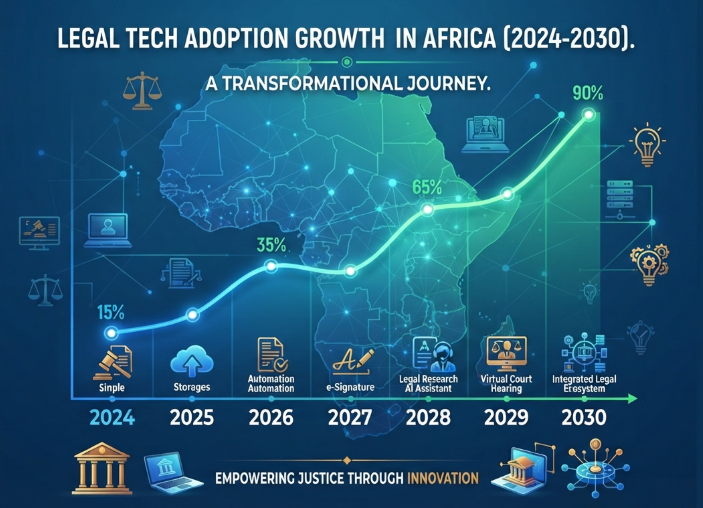
[IMAGE 2 SUGGESTION: An infographic-style image showing a rising line graph labeled with years 2024 to 2030, symbolizing legal tech adoption growth in Africa. Position: after this section, before the “7 Trends” section. Alt text: “graph showing the future of legal tech in Africa adoption growth 2024 to 2030”]
7 Trends Shaping the Future of Legal Tech in Africa
Here are the developments worth watching closely over the next few years. For a broader look at how these shifts are already playing out day to day, see our full breakdown of legal tech trends in Nigeria.
- AI-assisted legal research becomes the default, not the exception. Lawyers who once spent entire afternoons in law libraries can now query AI systems that pull relevant statutes, case law, and regulations in seconds. This does not replace legal judgment; it simply removes the grunt work that used to eat up billable hours.
- Government tender databases go fully searchable. Instead of monitoring dozens of separate procurement portals, businesses and contractors will increasingly rely on unified, AI-powered databases that surface relevant opportunities automatically, based on sector, location, and contract value.
- Compliance monitoring becomes proactive instead of reactive. Regulated industries such as banking, telecoms, and oil and gas are moving toward tools that flag regulatory changes as they happen, rather than forcing compliance teams to discover new rules after the fact.
- Access to justice expands for everyday citizens. Plain-language legal explainers, AI chat interfaces, and searchable rights databases are giving ordinary Nigerians a level of legal literacy that used to require hiring a lawyer just to ask a basic question.
- Courts adopt unified case management systems. As detailed in our piece on Nigeria’s judicial digital transformation, the shift toward centralized digital court systems is already underway at the highest levels of the judiciary.
- Legal education modernizes. Law students and researchers increasingly train on digital-first legal research, meaning the next generation of Nigerian lawyers will expect AI-assisted tools as a baseline, not a luxury.
- Cross-border legal data starts to connect. As African nations align more closely under continental AI and trade frameworks, cross-border legal research, particularly for businesses operating in multiple African markets, is expected to become significantly easier over the next several years.
What This Means for Nigerian Lawyers and Businesses
For practicing lawyers, this shift is mostly good news. Automating research and document review does not eliminate legal expertise; it frees up time for the strategic thinking that actually requires a trained legal mind. Firms that adopt these tools early tend to serve more clients without sacrificing quality, which is a genuine competitive advantage in a crowded market.
For corporate legal departments and compliance officers, the future of legal tech in Africa means fewer surprises. Instead of discovering a regulatory change weeks after it takes effect, teams can monitor updates in real time.
For SMEs and contractors, digitized tender databases mean a fairer playing field. A small construction firm in Enugu now has roughly the same visibility into federal contracts as a large firm headquartered in Lagos, provided they know where to look.
If you want a deeper look at the practical tools already available, our guide on AI tools for lawyers in Nigeria and our roundup of the best legal research tools for Nigerian lawyers are good next reads.

The Challenges Standing in the Way
None of this is happening without friction, and it would be dishonest to pretend otherwise.
Internet infrastructure remains uneven across Nigeria, particularly outside major cities, which slows adoption of any cloud-based legal tool. Digital literacy also varies widely; a platform can be powerful, but it only helps people who know how to use it.
There is also the question of trust. Lawyers, understandably, are cautious about relying on AI for anything touching client confidentiality or case strategy. Robust data protection, especially in light of Nigeria’s evolving identity and data regulations, has to be a non-negotiable foundation for any legal tech platform operating in this space.
Regulatory clarity is still catching up too. Across the continent, governments are moving from policy workshops toward national strategies, draft legislation, and direct judicial scrutiny of AI, but the pace differs significantly from country to country. Nigeria will need clear, practical rules that protect users without stifling innovation.
How Platforms Like Lexark Fit Into This Shift
This is where platforms built specifically for the Nigerian legal landscape come in. Lexark brings together laws and regulations, the government tenders database, and AI-assisted legal research into one searchable platform, built for Nigeria’s specific legal and procurement environment.
The goal is not to replace lawyers or compliance professionals. It is to give them, and the businesses and individuals who rely on them, the same instant access to legal information that used to be reserved for large firms with big research budgets. That is really what the future of legal tech in Africa is about: leveling the playing field.
Conclusion
The future of legal tech in Africa will not be decided by a single company or a single piece of legislation; it will be shaped by thousands of small decisions, made by lawyers, businesses, and everyday citizens, about which tools they choose to trust with their legal work. Nigeria is already at the center of that shift.
So here’s the question worth sitting with: when the tools finally catch up to the size of the opportunity, will your firm or business be ready to use them, or still searching through the old filing cabinet?
Leave a Reply