

Table of Contents
How Lawyers Can Automate Legal Research: Nigerian lawyers can automate legal research by using AI-powered platforms that search statutes, retrieve case law, summarize judgments, and flag relevant precedents within seconds. Instead of spending hours combing through physical law reports or disconnected digital databases, automation tools allow legal practitioners to enter a query in plain language and receive verified, jurisdiction-specific results instantly. This guide breaks down seven practical approaches every lawyer in Nigeria can adopt today.
Why Legal Research Automation Matters in Nigeria
There is a common joke among Nigerian lawyers; the one who finds the right case law first, wins. And while that is a bit of an exaggeration, it carries more truth than most practitioners would like to admit.
Traditionally, legal research in Nigeria has been a labor-intensive process. Lawyers spend long hours poring over physical law books, flipping through outdated indexes, and navigating poorly maintained digital databases; hoping to find the one judgment that will make or break their client’s case.
According to a 2025 report by the National Judicial Institute, there are an estimated 200,000 unresolved cases in Nigeria’s court system. A significant part of that backlog traces back to how long it takes lawyers and courts to process, retrieve, and act on legal information.
The good news? Automation is changing that reality. Fast.
AI-powered legal research tools in Nigeria are no longer experimental luxuries reserved for big firms in Victoria Island. They are becoming practical, affordable necessities for any lawyer who wants to remain competitive in 2026 and beyond.
What Does Automating Legal Research Actually Mean?
Before we dive into the specific strategies, it helps to be clear about what automation actually looks like in the context of legal research.
Automating legal research does not mean replacing lawyers with robots. It means using intelligent software to handle the repetitive, time-consuming parts of research so that lawyers can focus on what requires human judgment; analysis, strategy, and advocacy.
Think of it this way. When a lawyer manually searches for relevant case law, they might spend four to six hours cross-referencing judgments, reading through headnotes, and verifying citations. An AI-assisted tool can narrow that same search to the most relevant authorities in a matter of minutes; with confidence scores attached to each result.
That is the shift. Not replacement; amplification.
7 Ways Lawyers Can Automate Legal Research in Nigeria
1. Use AI-Powered Search Platforms Built for Nigerian Law
The most immediate and impactful change any Nigerian lawyer can make is switching from generic search engines to platforms specifically trained on Nigerian legal content.
General tools like Google or even international legal databases such as Westlaw are not designed with Nigerian statutes, procedural rules, or court hierarchies in mind. They return results that may be technically relevant globally but practically useless in a Lagos courtroom.
Platforms like Lexark, LawPavilion’s TIMI AI, and Primsol are trained on Nigerian case law and statutes. When a lawyer enters a query, the system understands local legal language, jurisdictional distinctions, and the hierarchy of Nigerian courts; from Magistrate Courts all the way to the Supreme Court.
This matters because the question “can an employer terminate employment without cause in Lagos?” will yield a very different answer under Nigerian Labour law than under UK or US employment law. Jurisdiction-specific AI removes that risk of confusion.
For more on how AI tools are transforming legal practice in Nigeria, see our guide on legal tech trends in Nigeria.
2. Automate Case Law Retrieval With Confidence Scoring
One of the most frustrating parts of legal research is not finding a case; it is finding 40 cases and not knowing which ones are actually strong enough to cite.
Modern AI research tools now attach confidence scores to their search results. This means the platform tells you not just that a case is relevant but how relevant it is to your specific legal question; based on how closely it aligns with your matter’s facts, the court level, and whether it has been cited approvingly in subsequent decisions.
This is a significant upgrade from manually reading through dozens of headnotes to decide which judgment to use.
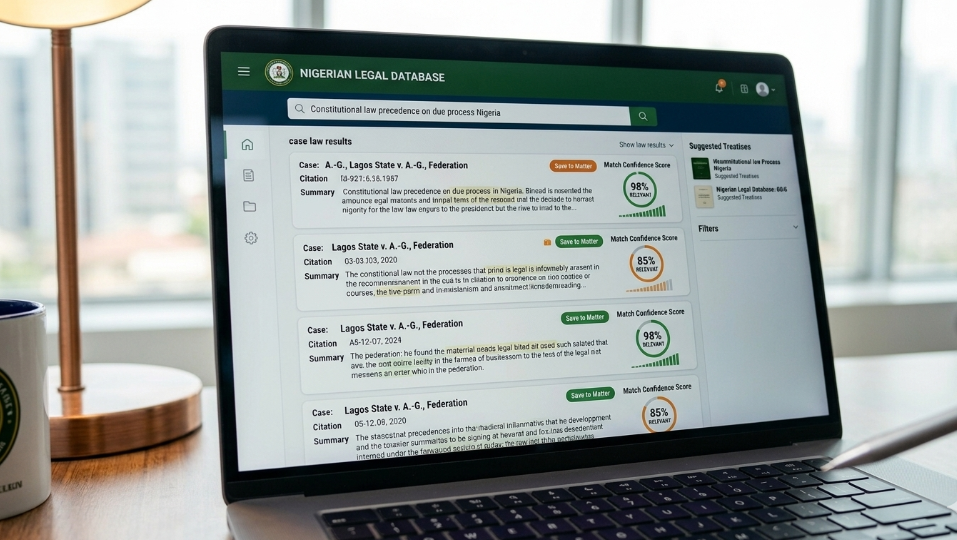
When you know how lawyers can automate legal research at this level, you stop second-guessing your citations and start building arguments with greater speed and certainty.
3. Set Up Automated Regulatory Alerts
Legal research is not only about past judgments. It also involves keeping up with changes in laws and regulations that affect your clients.
For lawyers who advise businesses in regulated industries; banking, telecoms, oil and gas, or data privacy; staying current is a full-time responsibility on its own. A regulation can change and take effect before a lawyer even hears about it, potentially exposing a client to liability.
Automated regulatory alerts solve this problem elegantly. A well-configured AI platform can monitor specific areas of Nigerian law and notify you by email or dashboard alert whenever a relevant law is amended, a new regulation is gazetted, or a significant new judgment is delivered.
This keeps you current without requiring you to manually scan government portals or gazette publications every week.
4. Use AI to Summarize and Extract Key Issues From Long Judgments
Lengthy Supreme Court judgments and Court of Appeal decisions can run into hundreds of pages. Reading every page to extract the principle of law you actually need is not just tedious; it is impractical when you have multiple active matters running simultaneously.
AI summarization tools allow a lawyer to upload a judgment and receive a structured summary that highlights the key legal issues decided, the ratio decidendi, and any dissenting opinions; in plain language and in a fraction of the time it would take to read manually.
This is not about cutting corners. It is about knowing which judgments deserve your full attention and which ones can be dealt with at summary level.
5. Automate Document Drafting With Precedent Libraries
Research and drafting are two sides of the same coin in legal practice. Once a lawyer finds the right legal authorities, the next step is incorporating them into a brief, pleading, or legal opinion.
AI-assisted drafting tools that are connected to a precedent library can take the research output and use it to populate document templates; automatically inserting the right citations, procedural references, and boilerplate language.
This is especially useful for routine documents like Statements of Claim, Notices of Appeal, or standard affidavits; where the structure is predictable even if the facts change from client to client.
6. Use Retrieval-Augmented Generation (RAG) to Reduce Errors
Here is something that not enough Nigerian lawyers are paying attention to: the risk of AI hallucination.
Some popular general-purpose AI tools have a known problem; they occasionally fabricate legal citations. They will confidently produce the name of a case, a court, a year, and a holding; and none of it will actually exist. This is called hallucination, and it is particularly dangerous in legal work where every citation is verifiable.
The good news is that a class of AI tools called Retrieval-Augmented Generation (RAG) systems addresses this directly. Instead of generating answers from general training data, RAG tools first retrieve information from a verified database before generating a response. This grounds every answer in real, checkable sources.
When choosing how lawyers can automate legal research, prioritizing platforms that use RAG architecture; rather than open-ended generative AI; significantly reduces citation errors and protects you from embarrassing mistakes in court or in written opinions.
For a deeper look at tools that follow this approach, visit our resource on the best legal research tools for Nigerian lawyers.
7. Integrate Research Tools With Case Management Systems
The final strategy is about workflow integration. Research does not happen in isolation; it is part of a broader case lifecycle that includes client intake, deadline management, document storage, and billing.
When your legal research platform is connected to your case management system, research outputs can be automatically tagged to the relevant matter, stored in the client’s digital file, and made accessible to other members of your team.
This eliminates the problem of research sitting in a separate browser tab or document folder, disconnected from the active case. It makes knowledge institutional rather than individual; so the work survives even when a team member is unavailable.

Common Mistakes Lawyers Make When Adopting Automation
Knowing the tools is only half the story. Many Nigerian lawyers who try to automate legal research run into the same avoidable errors.
Relying on tools not designed for Nigerian law. This is the most common mistake. Using a foreign AI tool to research Nigerian statutes is like using a map of London to navigate Lagos; the principle is the same, but the details are all wrong. Always prioritize jurisdiction-specific platforms.
Using automation as a substitute for judgment. AI accelerates research; it does not replace the lawyer’s ability to evaluate whether a case is applicable, how to distinguish unfavorable precedents, or how to argue effectively. Treat AI output as a capable first-year associate’s draft; review it before you use it.
Ignoring training and onboarding. A 2025 UNESCO study found that 91% of judicial professionals using AI tools reported having no formal training on those tools. Investing a few hours in learning how to write effective queries, interpret confidence scores, and configure alert settings will multiply your returns significantly.
How Lexark Fits Into Your Automated Research Workflow
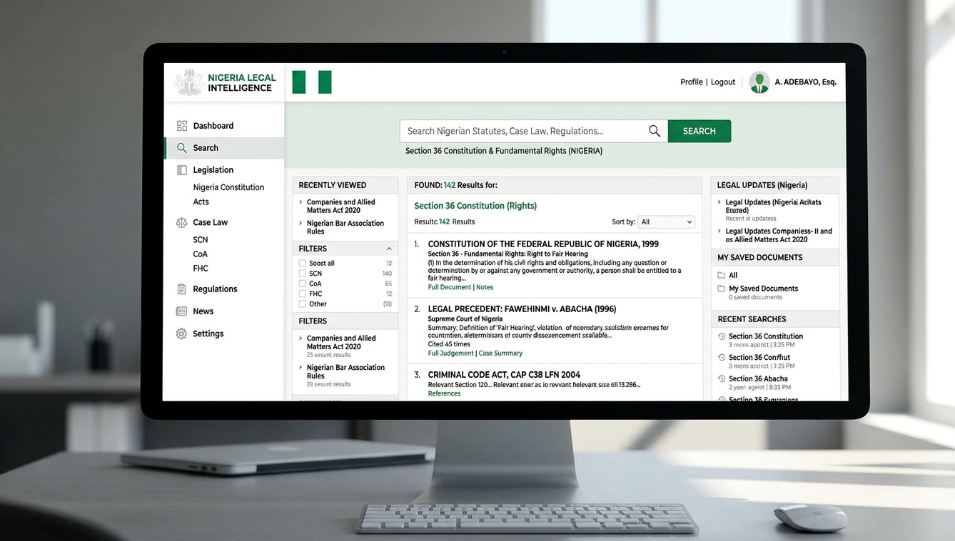
Lexark (lexark.org) is an AI-powered legal intelligence platform built specifically for Nigeria. It brings Nigerian laws, regulations, and government tenders together in one searchable, AI-assisted interface.
For lawyers, this means you can search statutes and case law without switching between multiple disconnected portals. For compliance teams and corporate legal departments, it means staying current on regulatory changes without manually monitoring dozens of government websites.
The platform is designed to be accessible; not just to senior partners in large firms, but to individual practitioners and in-house counsel who need reliable legal intelligence without enterprise-level pricing.
Follow Lexark on Instagram at @lexarklegal for updates, legal insights, and product news.
Conclusion
The question is no longer whether Nigerian lawyers should automate legal research. The question is how quickly they can get comfortable doing it.
AI will not replace good lawyers. But AI-equipped lawyers will consistently outperform those who rely entirely on manual processes; in speed, accuracy, and the ability to serve more clients without burning out.
The seven strategies in this guide represent a practical starting point. You do not need to implement all of them at once. Start with a jurisdiction-specific search tool, explore automated alerts for your practice area, and build from there.
The Nigerian legal landscape is changing fast. The lawyers who adapt earliest will be the ones writing the next generation of precedents; not chasing them.
Are you still spending four to six hours on research that an AI tool could complete in minutes; and if so, what is stopping you from making the switch today?